Battle reserve
The Good ShepherdBattle reserve is the capacity a ship and its crew must retain for a crisis still to come. In Krause’s command of Keeling, it is both a practical limit on immediate action and a discipline of command: fuel, ammunition, crew endurance, and attention cannot be spent as though the present contact were the only danger the convoy would face.
Operational Meaning and Tactical Reserves
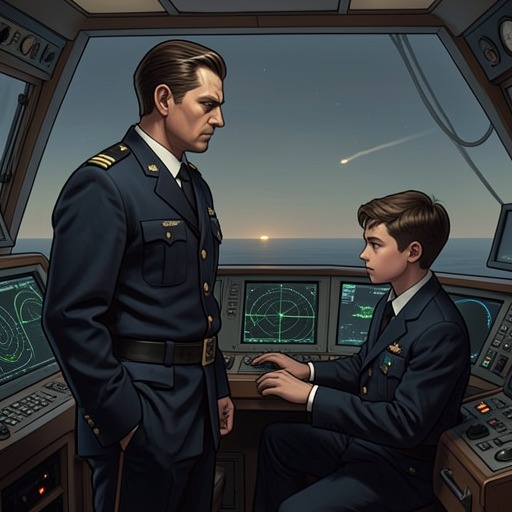
Krause’s first calculation begins with an uncertain report from James: a distant contact bearing three-five-five, with a request to attack. The bearing placed the possible U-boat several miles from the convoy and forward of its port beam, while a change of course was due in fourteen minutes and would turn the convoy away. Detaching James, possibly with Viktor, might destroy a submarine, but it would also thin an escort screen of only four fighting ships. The ships left in station would have to cover the convoy’s immense front with sonar; detachments could leave gaps for other U-boats to exploit.
Fuel made the choice harder. James would need to accelerate, search at a distance from the convoy, and later rejoin at high speed while the convoy continued away from her. That pursuit could consume an hour, two, or three at increased speed, using some of the small fuel reserve. Krause’s professional training had taught him to keep a reserve available for the crisis of battle. The possible gain of killing a U-boat had to be weighed against the danger of spending fuel and escort coverage before the scale of the threat was known.
The threat was not merely the submarine that might be attacked. If it escaped, it could report the convoy’s presence by radio, observe its course and speed from the surface, and help summon a wolf-pack. Destroying it, or keeping it submerged long enough for the convoy to get away, could deny the Germans that information and make it harder to find the convoy again. The reserve principle therefore did not mean avoiding action at any cost: Krause had to compare the resources spent in pursuit with the greater danger of allowing the contact to operate freely.
Crew Endurance and Battle Stations
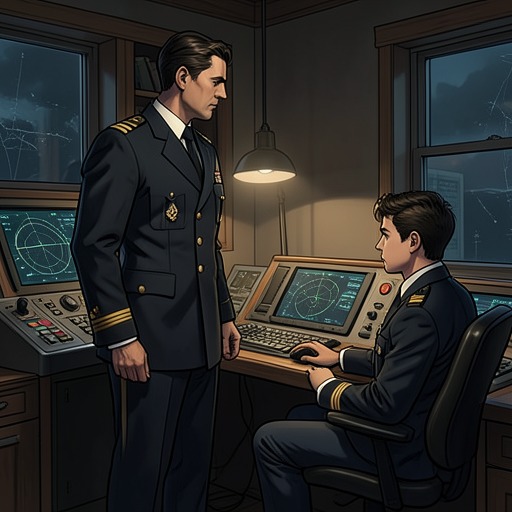
The same logic governs when Krause refuses to call General Quarters. Carling is ready to sound the alarm after learning that James is pursuing a contact with Viktor’s help, but Krause judges that this alone is not sufficient reason. General Quarters would send every man to his post, stop ordinary shipboard work, and leave the crew without normal opportunities to sleep or eat. Routine maintenance would be deferred, fatigue and hunger would accumulate, and a state sustainable for hours would consume the crew’s battle reserve. Keeling is already at Condition Two, which strains the crew and disrupts routine, but can be endured for days rather than hours.
Krause also accounts for the effect of repeated alarms. If men are continually called to meet demands that appear unjustified, some may become slack in carrying out their duties. His refusal is a rapid judgment formed from long experience, not indifference to the contact: the escort’s pursuit does not yet justify imposing the sharper and shorter-lived strain of battle stations on the whole ship. His judgment also includes Carling’s readiness to sound the alarm, which Krause quietly records as evidence relevant to his assessment of Carling’s fitness for command.
Later, after a prolonged action, Krause orders the ship to secure from General Quarters and return to Condition Two. He asks Charlie Cole to arrange hot food for the men off watch. Half the crew can then eat, rest, and warm themselves, while the ship retains a heightened readiness. When Krause realizes that the crew has spent nearly three hours at General Quarters, he regrets having called them to battle stations at all. That recognition does not undo the fatigue already incurred; it makes restoring the reserve an immediate part of command.
At the four o’clock watch relief, the men coming off duty can finally relax. Krause wants to rebuild the battle reserve he believes he has recklessly drawn upon, because a long period of strain still lies ahead. He expects to fight in Condition Two if necessary, with half the ship off duty; some sailors, he knows from experience, may even sleep through the firing of guns and the explosions of depth charges. Readiness is not identical with keeping every person awake and at a battle station. It depends on preserving enough rested capacity to respond when a genuine crisis requires it.
Ammunition and Successive Engagements
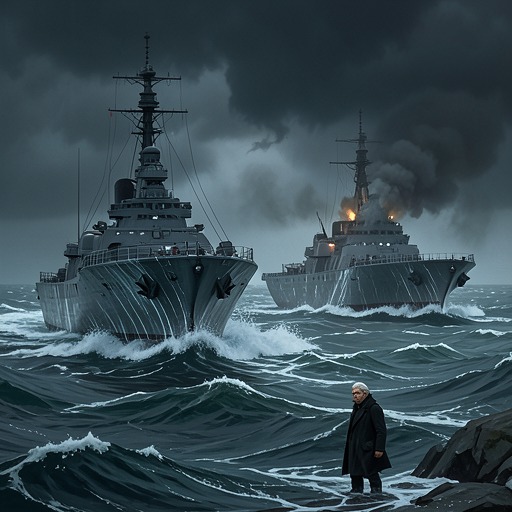
Battle reserve also has a literal material limit. After a day of fighting, Keeling has expended thirty-four depth charges in the latest sequence, bringing the pattern’s total to thirty-eight. More than seven tons of high explosive have gone over the side in twenty-four hours. Only six charges remain, including extra ones brought up from the crew’s living quarters. Krause orders an end to firing patterns: the ship can no longer treat each contact as an opportunity for an unchanged attack.
Scarcity changes the odds of what remains possible. The area searched by a depth-charge pattern varies with the square of the number of charges: halving a pattern leaves only a quarter of its previous chance of a hit, while reducing it to a third leaves one-ninth. Yet even a single charge exploding within a submarine’s hearing can have a deterrent effect, forcing evasive action at least temporarily. The remaining weapons therefore retain value beyond the chance of a direct hit, but their limited number makes every further use a choice against future need.
Krause also considers what may make another engagement less likely or alter its cost. By the next morning Keeling should be within the radius of air cover, and he expects that moderating weather may make such protection possible. He has also seen evidence that U-boats have recently avoided attacking convoys in the eastern Atlantic. These expectations do not replenish the six remaining charges; they inform how he judges the danger of conserving them against the prospect of having to fight again.
Readiness as a Continuing Command Problem
The ship’s readiness depends on more than fuel and explosives. Lookouts must sweep their assigned sectors without interruption, even as spray forces them to wipe their binocular lenses. A periscope might appear only briefly, and a moment’s sighting could decide the convoy’s fate. Below, Tom Ellis has spent months listening to sonar pings but has never heard an echo from a submarine since his hurried training. The account emphasizes how much an attack can depend on an operator’s ability to recognize an unfamiliar echo and react accurately. The equipment and crew are not interchangeable stores of capacity: their usefulness depends on sustained attention, practice, and the conditions under which they work.
Krause later changes the watch routine to protect that human capacity. Because Keeling’s new weapons and instruments require additional personnel, living space is crowded and there are not enough trained ratings to provide three watches at Condition Two. He divides the ship’s company into four sections and uses a watch-and-watch routine, seeking to give the men as much rest as possible without imposing an unnecessary call to General Quarters. Most officers work four hours on and eight off. On a watch when the crew is already keyed up and ready, he cancels routine General Quarters and allows the watch below a full four hours unless an emergency occurs. The decision protects rest without pretending the ship is free of danger.
The principle reaches Krause’s own body as well. Exposed on the bridge without his proper warm clothing, he is chilled so badly that his hands become numb and a pencil falls from them. After roughly thirty hours of wakefulness, he nearly falls asleep on his stool and is shocked by the lapse. He forces himself to stand, treating physical discomfort as a safeguard against sleep. The episode shows the limits of a command system that depends on sustained vigilance: resolve can resist fatigue for a time, but it cannot make the body inexhaustible. Across fuel, weapons, watches, and attention, battle reserve means preserving options—and recognizing that every demand made now narrows what can be asked later.